 English
Author: Site Editor Publish Time: 2026-06-23 Origin: Site


A 5/8" wedge anchor requires exactly a 5/8" masonry drill bit. You cannot size up or size down. Unlike standard wall fasteners, these specific anchors rely entirely on exact dimensions to function properly. The mechanical friction created by the expansion clip against the concrete walls dictates their holding power. If you bore a hole too wide, the anchor will spin freely. If you bore it too narrow, you risk cracking the base material.
Getting this process right demands more than just matching numbers. We will guide you through confirming exact bit specifications and avoiding common errors. You will learn how to identify crucial ANSI tolerance requirements for drilling tools. We will also explain how to match your fastener materials to the specific environmental application. Finally, we detail a standardized installation protocol. Following these rules ensures your project achieves safe, reliable load rating compliance.
Exact Match: The drill bit diameter must identically match the anchor diameter (use a 5/8" bit for a 5/8" wedge anchor).
ANSI Compliance: Only use carbide-tipped drill bits that meet ANSI B212.15 standards to guarantee hole tolerance.
Depth Rule: Always drill the hole at least 1/2 inch deeper than the intended anchor embedment depth to accommodate concrete dust and debris.
Material Selection: Choosing between zinc-plated, hot-dipped galvanized, or stainless steel is critical for long-term structural integrity and corrosion resistance.
The sizing principle here is remarkably straightforward. Industrial concrete fasteners follow a strict 1:1 sizing rule. The nominal diameter of a wedge anchor always equals the required hole diameter. There is absolutely no guesswork involved. You do not need to down-size the bit to create a tighter fit. The engineered expansion clip handles the gripping action automatically once torqued.
Standard drill bits often fail during critical structural installations. To prevent failure, you must use bits meeting ANSI B212.15 standards. This specific certification enforces strict manufacturing tolerances. It prevents manufacturers from producing bits outside a very narrow dimensional window. Concrete bit tips wear down quickly during heavy use. However, an ANSI-certified bit ensures the initial hole never bores too wide.
Using a non-ANSI, worn, or cheap bit causes massive installation problems. These inferior bits often wobble during operation. This wobble creates an oversized or oval-shaped hole. When you insert the fastener into an oversized hole, the clip cannot catch the concrete matrix. The entire unit will simply spin in place. It will fail to achieve the required torque.
Here is a quick comparison table illustrating the difference between standard and ANSI-compliant bits:
Feature | Standard Masonry Bit | ANSI B212.15 Certified Bit |
|---|---|---|
Tolerance Control | Loose; varies by batch | Extremely strict; highly regulated |
Carbide Tip Quality | Basic grade; chips easily | Industrial grade; resists high heat |
Hole Precision | Prone to creating bell-mouthed holes | Creates perfectly cylindrical holes |
Application Suitability | Light duty; plastic anchors | Heavy duty; structural expansion anchors |
Drilling a 5/8" hole into solid concrete requires serious impact force. SDS-Plus or SDS-Max rotary hammer drills are mandatory for this task. You should never use standard drill/drivers. A standard drill will walk across the concrete surface and burn out the bit quickly. More importantly, standard drills create uneven, bell-mouthed holes. Rotary hammers provide the exact percussive energy needed to pulverize the concrete cleanly.
Selecting the right hole size is only half the equation. You must also evaluate the surrounding environment carefully. Using the wrong material for your specific climate leads to disaster. Moisture causes premature shear or tensile failure via heavy corrosion. To prevent this, you must select the appropriate protective coating or alloy.
We can categorize these fasteners into three primary material solutions. Each serves a distinct environmental purpose:
Zinc-Plated Carbon Steel: This is best for dry, indoor environments only. It is highly cost-effective for climate-controlled buildings. However, it remains highly vulnerable to moisture and rust.
Hot-Dipped Galvanized (HDG): We recommend this for treated lumber applications and moist outdoor environments. The thicker zinc coating offers excellent medium-term protection against the elements.
300-Series Stainless Steel (304/316): This alloy is mandatory for marine environments, chemical plants, or continuous water exposure. It carries a high initial cost but provides the lowest failure risk overall.
Use this summary chart to identify the best material for your specific project:
Material Type | Environment | Corrosion Resistance | Best Use Case |
|---|---|---|---|
Zinc-Plated | Indoor / Dry | Low | Interior structural framing, shelving |
Hot-Dipped Galvanized | Outdoor / Moist | Medium to High | Exterior sill plates, treated lumber |
304 Stainless Steel | Wet / Light Chemical | High | Outdoor fixtures, moderate weather |
316 Stainless Steel | Marine / Submerged | Maximum | Saltwater docks, chemical plants |
You also need to calculate the exact fastener length required. Many people mistakenly buy anchors based only on the fixture thickness. Clarify the length using this strict formula:
Minimum Embedment Depth + Fixture Thickness + Nut/Washer Allowance = Minimum Anchor Length.
Always verify the manufacturer's specified minimum embedment depth. Adding the nut and washer allowance usually requires an extra 5/8 to 3/4 of an inch. Never guess these dimensions.
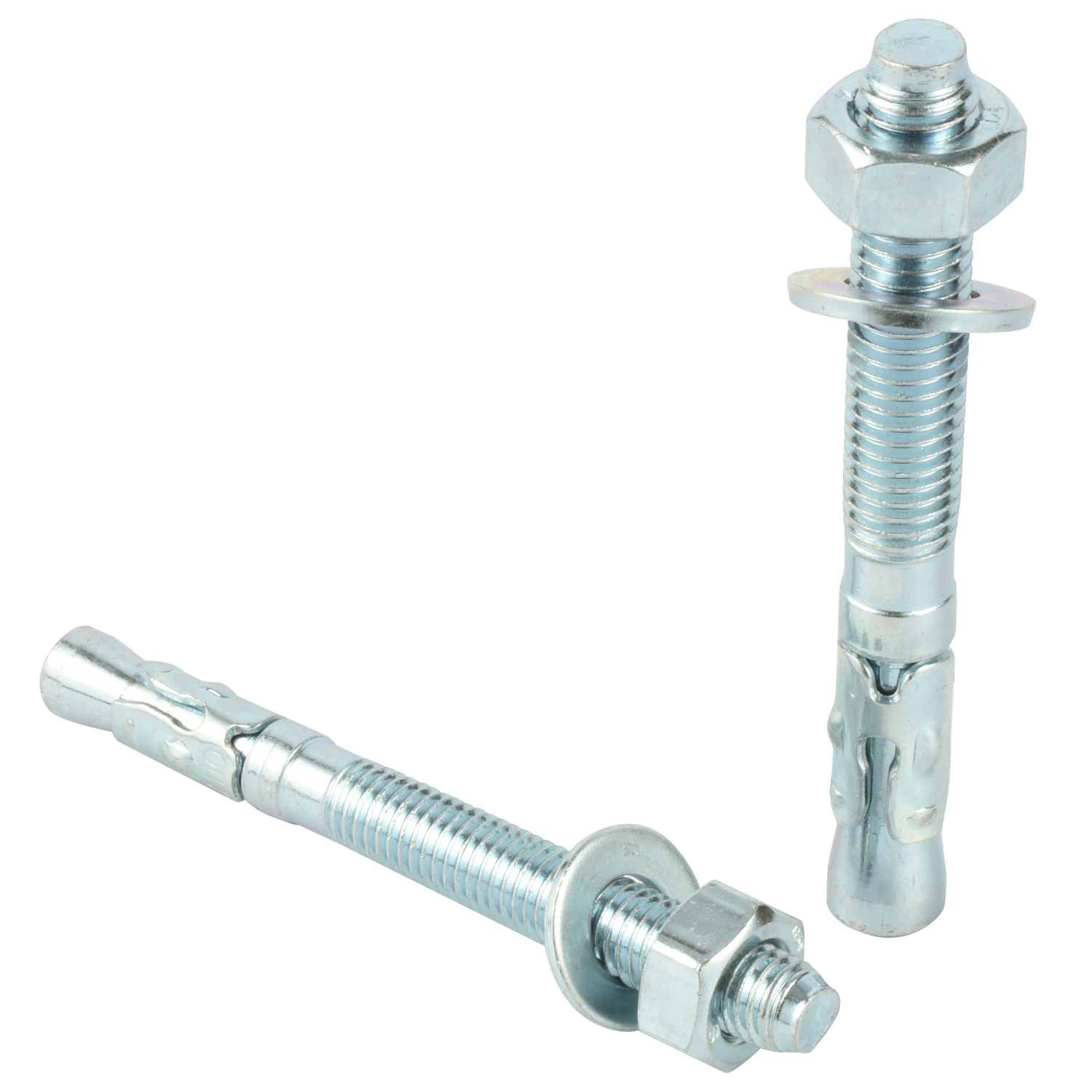
Even perfectly sized hardware can fail if installed incorrectly. We see many projects suffer due to poor site execution. You must understand these three critical implementation risks to ensure maximum structural safety.
Drilling into concrete generates a massive amount of fine silica dust. Leaving impacted dust inside the hole prevents the expansion clip from gripping the concrete matrix properly. When the clip cannot bite into clean concrete, it slides upward. You must use the standard blow-brush-blow method to clean it. First, use compressed air to blow out loose dust. Next, scrub the sides using a wire brush. Finally, blow it out again. Commercial sites must also ensure strict OSHA silica dust compliance during this process.
You must drill deeper than you think. If the hole is not drilled at least 1/2" deeper than the intended embedment, you face a major issue. The wedge anchor will bottom out on compressed dust before the nut secures the fixture. When it bottoms out, you cannot drive it further. Removing a partially expanded fastener is nearly impossible. Always set a mechanical depth gauge on your rotary hammer.
Applying the correct rotational force is non-negotiable. Both extremes compromise the connection severely.
Under-torquing: If you apply too little force, the wedge clip never fully expands. This directly risks a catastrophic pull-out under load.
Over-torquing: Applying too much force strips the metal threads completely. Worse, it can crush the concrete surrounding the expansion zone.
We strongly advise using a calibrated torque wrench. A standard 5/8" fastener typically requires around 90 ft-lbs of torque. However, you must strictly defer to the specific manufacturer spec sheets for exact values.
Following a standardized sequence removes human error from the equation. Use these exact steps to achieve the stated load capacities safely.
Step 1: Drilling. Position your rotary hammer perfectly perpendicular to the concrete surface. Use a fresh 5/8" ANSI-rated bit. Set your drill depth gauge to the required embedment depth plus an extra 1/2 inch. Bore the hole steadily without forcing the tool.
Step 2: Clearing. Remove the drill bit. Use compressed air or a specialized vacuum nozzle to clear the loose powder. Run a stiff wire brush up and down the hole walls. Blow the dust out one final time to ensure a pristine gripping surface.
Step 3: Preparation. Take your hardware and thread the nut onto it. Turn the nut until it sits completely flush against the top of the threaded section. This positioning protects the delicate threads from heavy hammer strikes during insertion.
Step 4: Seating. Align your fixture over the hole. Drive the unit through the fixture hole and down into the concrete. Use a heavy hammer for this step. Stop striking when the washer sits completely flush against the fixture surface.
Step 5: Torquing. Grab your calibrated torque wrench. Tighten the nut precisely to the manufacturer’s specified foot-pounds. If a wrench is completely unavailable, tighten it 3 to 5 full turns past hand-tight.
Sourcing your hardware correctly is your final crucial step. The construction market contains plenty of cheap, unbranded fasteners. You should aggressively avoid these for any structural applications.
Advise your procurement team against buying low-grade items. Instead, look specifically for hardware carrying ICC-ES (International Code Council Evaluation Service) approvals. The ICC-ES stamp verifies rigorous testing. It guarantees performance in both cracked and uncracked concrete environments. Engineers universally trust these certifications for heavy structural loads.
Before placing a bulk order, review your local building codes thoroughly. Municipalities often dictate specific minimum embedment depths. They may also enforce strict seismic performance ratings based on your geographic fault lines. Gather these exact specifications first. Then, purchase your approved wedge anchor supplies alongside matching ANSI-certified SDS bits.
The overall success of your installation hinges entirely on using a 5/8" ANSI-compliant masonry bit. Cutting corners on bit sizing directly compromises structural integrity. Precise dimensional matching ensures the expansion clip functions exactly as engineered. Remember these action-oriented next steps for your upcoming project:
Always verify your bit carries the ANSI B212.15 certification before drilling.
Drill holes exactly perpendicular and add 1/2 inch extra depth for dust clearance.
Thoroughly extract all silica dust using the blow-brush-blow technique.
Review your environmental moisture levels to select the correct metal alloy.
Apply final torque strictly using a calibrated wrench to hit manufacturer specs.
A: The anchor will simply not fit into the hole. Forcing it down with a heavy hammer will bend the metal shaft severely. It will also damage the delicate threads or crack the surrounding concrete. You must always use an exact 1:1 matching bit size.
A: Generally, the standard minimum embedment for a 5/8" anchor is 2-3/4 inches. However, engineers must consult the specific manufacturer's technical data sheet. Different brands and material types carry unique testing data necessary for accurate structural load ratings.
A: No. Wedge anchors are strictly designed for solid concrete applications. Using them in brick or hollow block will cause the base material to fracture and blow out completely. Sleeve anchors or chemical epoxy systems are required for these softer masonry materials.
A: Most manufacturers require a minimum edge distance of at least 5 to 6 times the anchor diameter. For a 5/8" size, this equals approximately 3-1/8" to 3-3/4". This distance prevents the concrete from spalling or blowing out sideways when the clip expands.
