 English


Selecting the right concrete fastening system often feels overwhelming. You must navigate conflicting load-rating data while understanding strict base-material constraints. One wrong choice compromises structural integrity and safety. The steel wedge anchor offers a proven solution. It remains the industry standard for heavy-duty, permanent fastening in solid concrete. Engineers heavily favor it because it delivers immediate load-bearing capabilities right after installation.
However, deploying it safely requires more than reading a simple specification sheet. This comprehensive guide breaks down the mechanical realities behind these fasteners. We explore complex load-bearing mathematics, including vital ACI and LRFD considerations. We also examine strict material compliance requirements for various environments. By reading this guide, you will learn how to verify spatial engineering rules and execute flawless installations. You can finally ensure safe, specification-compliant procurement across your most demanding structural projects.
Strict Base Limitations: Wedge anchors are engineered exclusively for solid concrete; they will fail if deployed in brick, block, or unreinforced masonry.
True Diameter Advantage: For a given drill-hole size, wedge anchors provide a thicker, stronger steel rod compared to sleeve anchors.
The 4:1 Safety Rule: Never design based on ultimate load capacity. Industry standards dictate a 25% working load (4:1 safety factor).
Spatial Engineering: Installation requires strict adherence to the 5D edge rule and 10D spacing rule to prevent cone-shaped pressure collapse in the concrete base.
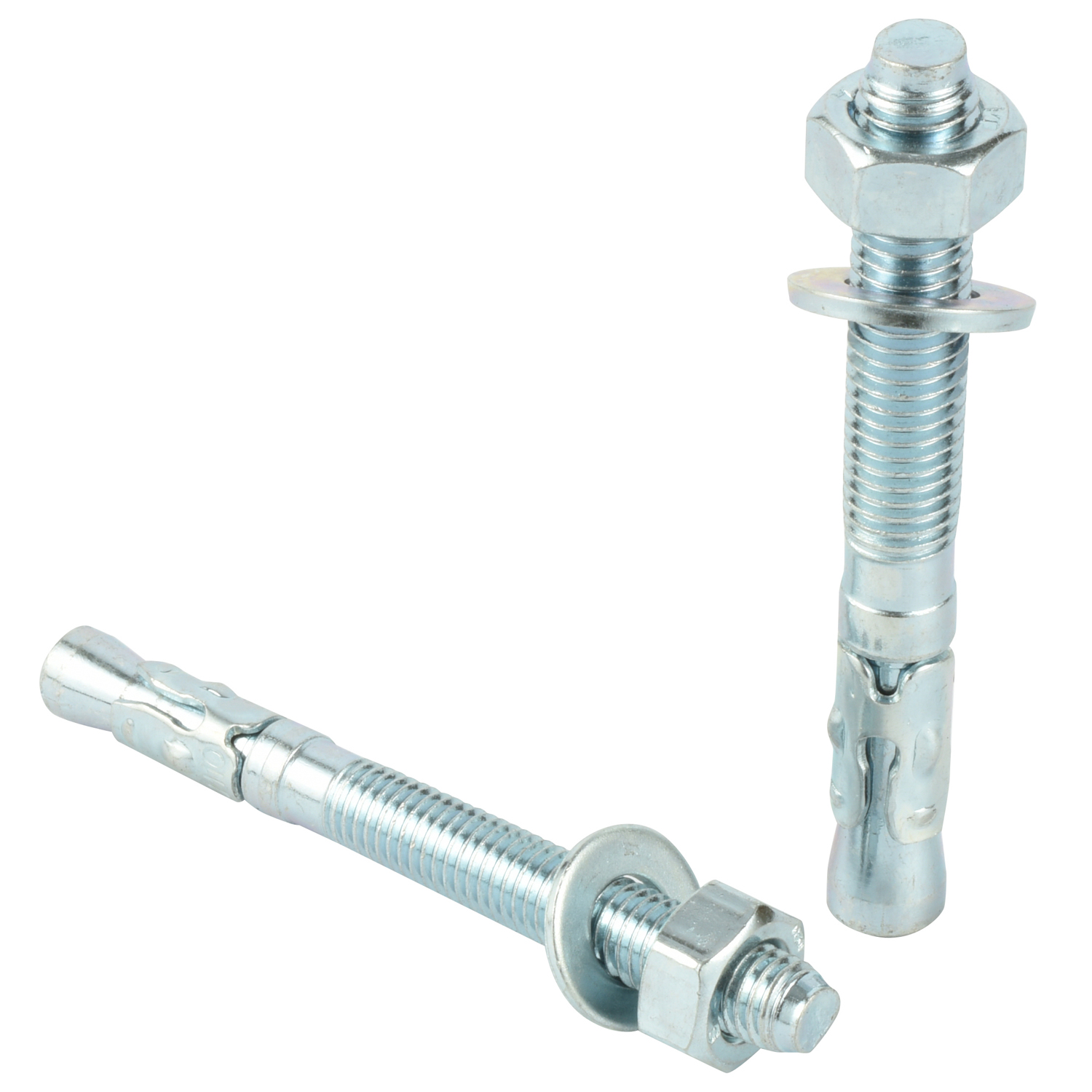
Every Wedge anchor relies on precise mechanical friction to hold immense weight. To understand this grip fully, we must examine its structural anatomy. The assembly features four critical components working in unison:
The Threaded Anchor Body: A solid steel rod featuring standard threads on top and a precision-tapered neck at the bottom.
The Expansion Clip: A small metal collar permanently attached around the tapered neck. It features specialized gripping teeth.
The Hex Nut: A heavy-duty nut used to apply torque and lock the fastened material in place.
The SAE-Standard Washer: A flat metal ring. It distributes the clamping load evenly and prevents damage to your fixture.
You trigger the expansion mechanism through simple mechanical torque. First, you drive the fastener into a pre-drilled hole. The fit remains tight. Next, you begin turning the hex nut with a calibrated wrench. As the nut travels downward, it forcefully pulls the tapered end of the body upward. This upward motion forces the expansion clip outward. The clip bites aggressively into the solid concrete walls. This mechanical friction grip provides immediate, immense holding power.
You must understand where these units excel and where they fail. Knowing these boundaries prevents catastrophic structural issues.
Ideal Use Cases: They dominate heavy industrial applications. You should use them for structural steel frameworks, heavy machinery mounts, and industrial pallet racking. They also easily secure massive conveyor systems to facility floors.
Hard Constraints: You face strict limitations. These fasteners are entirely irreversible once expanded. Do not use them for applications requiring future reconfiguration or removal. Furthermore, avoid cracked concrete environments. You can only use them in cracked concrete if they carry a specific ICC-ES evaluation report explicitly approving them for tension zones.
Common Mistake: Installers often try to use them in hollow cinder block. The immense expansion force shatters the fragile block web, resulting in zero holding power.
Many contractors misunderstand load data in the field. They wrongly assume sleeve variants match the sheer strength of wedge variants. We need to debunk this sizing myth immediately. The confusion stems from the drill-hole size.
Imagine you drill a 3/8-inch hole. A wedge fastener requires a 3/8-inch threaded rod to fill that hole. However, a sleeve fastener requires outer casing. To fit a sleeve into that same 3/8-inch hole, the internal threaded rod shrinks to approximately 1/4-inch. This fundamental physical reality matters. It gives wedge fasteners a significantly thicker steel core. Therefore, they deliver vastly superior tensile and shear strength in identical hole sizes.
You will often compare these fasteners against heavy-duty concrete screws. They utilize entirely different gripping mechanisms.
Wedge Fasteners: They rely entirely on mechanical expansion and friction. They require lower initial torque during setup. They offer highly reliable, permanent holds for static, heavy loads. They handle sheer weight exceptionally well.
Large Diameter Screws: These utilize hardened, serrated threads. They physically cut deep into the concrete base. You might prefer screws for edge-close installations because they do not exert outward expansion pressure. They also perform better in cracked concrete. You can remove them easily if needed. However, they generally carry a higher per-unit price tag and require more driving torque.
Feature | Wedge Type | Sleeve Type | Concrete Screw |
|---|---|---|---|
Core Diameter | Matches hole size (Maximum strength) | Smaller than hole size (Reduced strength) | Matches hole size (High strength) |
Grip Mechanism | Mechanical Friction / Expansion | Mechanical Friction / Expansion | Thread Cutting / Interlocking |
Removability | Permanent (Must be cut off) | Permanent or very difficult | Fully removable |
Edge Distance Requirement | High (Requires generous spacing) | High (Requires generous spacing) | Low (Can sit closer to edges) |
Manufacturer specification sheets often look incredibly impressive. They usually list the "Ultimate Load" capacity. However, enterprise engineering strictly forbids designing around ultimate load. You must apply a 4:1 safety factor. This industry standard dictates your safe working load equals exactly 25% of the ultimate load. You use this massive safety margin to account for material inconsistencies and dynamic forces.
Furthermore, modern construction requires rigorous mathematics. You must apply LRFD (Load and Resistance Factor Design) and ACI (American Concrete Institute) frameworks. These codes provide precise mathematical multipliers to verify structural safety under various stress conditions.
When you expand the clip, it exerts immense outward force. This force does not simply sit at the bottom of the hole. It radiates upward toward the surface in a distinct cone shape. Engineers call this "cone-shaped pressure." The concrete inside this invisible cone actually holds the fastener in place. If you compromise this cone, the entire installation fails.
You must mitigate implementation risks through strict spatial engineering. Ignoring these rules causes the concrete pressure cones to fail catastrophically.
Rule Type | Mathematical Standard | Engineering Rationale |
|---|---|---|
Edge Distance Rule | 5D (5 x Anchor Diameter) | Prevents outward expansion force from blowing out the unsupported side of the concrete slab. |
Spacing Rule | 10D (10 x Anchor Diameter) | Prevents adjacent pressure cones from intersecting. Intersecting cones degrade total holding value rapidly. |
For example, if you install a 1/2-inch unit, you must keep it at least 2.5 inches away from any edge (5D). You must also space it at least 5 inches away from the next unit (10D). Following these spatial rules guarantees the pressure cone remains perfectly intact.
Finally, consider base material dependency. Your load capacity scales linearly with concrete compressive strength. A fastener installed in 4,000 PSI concrete holds significantly more weight than the exact same fastener in 2,000 PSI concrete. Always verify the actual PSI rating of your slab at the time of installation.
Selecting the correct material plating ensures structural longevity. You must match the metal to the specific environmental exposure risk. Failing to do so invites rapid galvanic corrosion.
This represents the most common and economical option. However, it suits only dry, indoor environments. You might use it for interior warehouse racking or indoor electrical panels. It remains highly vulnerable to rust during outdoor or chemical exposures. Never deploy standard zinc fasteners in exterior applications.
Building codes require Hot-Dipped Galvanized steel for exterior, moist environments. It features a thick, rugged layer of zinc coating. Pay attention to one crucial structural detail. Are you fastening to ACQ (Alkaline Copper Quaternary) treated lumber? Standard zinc will aggressively corrode when it touches ACQ chemicals. You must use HDG or stainless steel. It represents a legally and structurally mandatory choice to prevent sheer failure over time.
We consider stainless steel the absolute benchmark for severe environments. Use 304 stainless for general wet environments. Upgrade to 316 stainless for highly corrosive areas. The 316 variant contains molybdenum, which violently resists chloride degradation. Rely on 316 for coastal salt zones, chlorinated swimming pools, food processing facilities, and harsh chemical plants.
Even the strongest fastener fails if contractors install it poorly. You must follow a rigorous Standard Operating Procedure (SOP). This guarantees flawless results and maximum safety.
Mandate the use of ANSI-standard solid carbide drill bits (specifically ANSI B212.15). This exact tolerance matters greatly. Using worn or off-spec masonry bits creates slightly oversized holes. This critical mistake results in "spinners." A spinner is a ruined unit that rotates endlessly in the hole without ever expanding. You cannot fix a spinner; you must abandon the hole.
Always drill your hole at least 1/2-inch deeper than your intended embedment depth. Drilling concrete creates a substantial amount of silica dust. This extra half-inch creates a necessary empty reservoir at the bottom. It gives residual dust a place to go, ensuring the fastener can reach its proper depth without bottoming out early.
Never skip hole cleaning. You must emphasize the necessity of blowing and brushing out the hole. Use a wire brush and compressed air. We recommend the "blow-brush-blow" method. This prevents the clip from seating improperly in loose silica dust. Furthermore, highlight silica dust inhalation risks on your job site. Airborne silica causes severe lung damage. Installers must wear required PPE, including HEPA masks and safety eye protection.
You must strike the fastener with a heavy hammer to drive it into the tight hole. Instruct installers to thread the hex nut onto the top of the rod before striking. The nut must sit perfectly flush with the top of the steel body. This vital tactic protects the softer threaded metal. It prevents flattening the threads under the hammer blows, which would render the whole unit useless.
How do safety inspectors verify finished work? They cannot see into the concrete. Manufacturers solve this through the "Length Identification Chart." They stamp specific letters on the flat head of the rod. This ingenious system allows inspectors to verify the total embedded length long after the concrete cures.
Head Stamp | Total Anchor Length |
|---|---|
A | 1-1/2" up to 2" |
C | 2-1/2" up to 3" |
E | 3-1/2" up to 4" |
G | 4-1/2" up to 5" |
Best Practice: Always use a calibrated torque wrench for the final step. Impact drivers easily over-torque the nut. Over-torquing destroys the internal friction grip and strips the threads.
Evaluating a permanent concrete fastener goes far beyond checking the price per unit. You must perfectly match thread diameters and material platings to your site conditions. You also have to align embedment depths with the specific compressive strength (PSI) of the concrete. Always consider environmental hazards, such as coastal air or ACQ-treated wood, to prevent catastrophic corrosion.
Do not leave structural safety to chance. We encourage procurement teams and engineers to consult architectural blueprints against official ICC-ES evaluation reports. Contact your technical sales team today. They will help you calculate exact torque values and verify your spatial layout rules. Thorough preparation ensures your next build remains secure, code-compliant, and exceptionally strong.
A: No. Once expanded, they are permanently set into the concrete. The mechanical friction grip prevents upward extraction. To remove the protruding fixture, you must cut the steel rod perfectly flush with the concrete surface using an angle grinder.
A: Add the exact thickness of the material being fastened to the minimum required embedment depth of the anchor. Finally, add enough space for the nut and washer. The nut and washer space typically equals the anchor's own diameter.
A: This is usually caused by using an oversized or worn drill bit. It also happens if you hit rebar and deviate the hole. Finally, using an impact driver can over-torque the nut and destroy the friction grip. Only use calibrated torque wrenches.
A: Absolutely not. The intense expansion force will instantly crack or blow out the weaker masonry webbing. You must use sleeve anchors, tapcon screws, or chemical epoxy systems for hollow or fragile substrates.
