 English


Concrete fastening forms the literal foundation of modern construction and industrial safety. Specify the wrong fastener type, and you risk catastrophic structural failures. Poor selection leads directly to compliance violations and severe workplace hazards. Structural engineers and project managers must get this critical decision right every single time.
This article delivers a clear, evidence-based evaluation of what a wedge anchor is used for. We will explore exactly where it excels in the field. We will also detail its strict base-material limitations, preventing costly installation mistakes. You will see precisely how it compares to alternative concrete fastening systems.
We designed this guide for contractors, structural engineers, facilities managers, and serious DIYers. It provides the technical knowledge you need for successful project execution. You will discover how to achieve reliable, code-compliant holding power. Let us examine the mechanical principles, optimal field applications, and critical installation rules you must follow.
Primary Function: Heavy-duty, permanent fastening exclusively for solid concrete (not brick, block, or mortar).
Mechanism: Relies on mechanical expansion (friction) driven by torque, offering some of the highest and most consistent holding values in fastening.
Selection Criteria: The correct choice depends entirely on three factors: base material integrity (cracked vs. uncracked), environmental exposure (corrosion risk), and load requirements (shear vs. tension).
Implementation Risk: Improper hole size, inadequate cleaning, or ignoring edge-distance spacing rules will compromise the anchor's rated capacity.
Understanding how these fasteners function is critical for structural safety. A pure mechanical expansion principle drives their immense holding power. First, you insert the threaded steel body into a pre-drilled hole. Next, you tighten the hex nut located on the exposed threaded top. This tightening action pulls the entire anchor body upward.
As the body rises, it forces a flared, conical base up into a metal expansion clip. Industry professionals call this clip the wedge. The upward movement forces the clip to flare outward tightly against the concrete walls. Friction immediately takes over. This extreme outward pressure locks the fastener permanently into the base material.
Why do they require strictly solid concrete? The extreme outward pressure dictates this rigid rule. You need a highly dense, solid base material to absorb the internal stress. The friction creates massive outward force against the sides of the drilled hole.
If you install them in hollow block, the thin walls will fail. Brick and mortar joints will also fracture under the pressure. The mechanical expansion force simply blows apart softer masonry materials. Therefore, you must strictly limit their application to poured, solid concrete slabs, columns, or foundations.
Structural engineers also rigorously distinguish between cracked and uncracked concrete. Building codes frequently rely on ICC-ES (International Code Council Evaluation Service) evaluations. These authoritative standards govern fastener compliance globally.
Standard models typically carry safety ratings only for uncracked concrete. However, concrete naturally experiences micro-cracking over its lifespan. Tension loads and physical settling cause these microscopic fissures. Seismic zones drastically amplify this reality.
If you operate in earthquake-prone areas, you must specify seismic-rated fasteners. These specialized versions feature uniquely engineered expansion clips. They maintain holding power even when the surrounding concrete develops micro-cracks. Using unrated standard anchors in seismic zones violates structural codes and endangers lives.
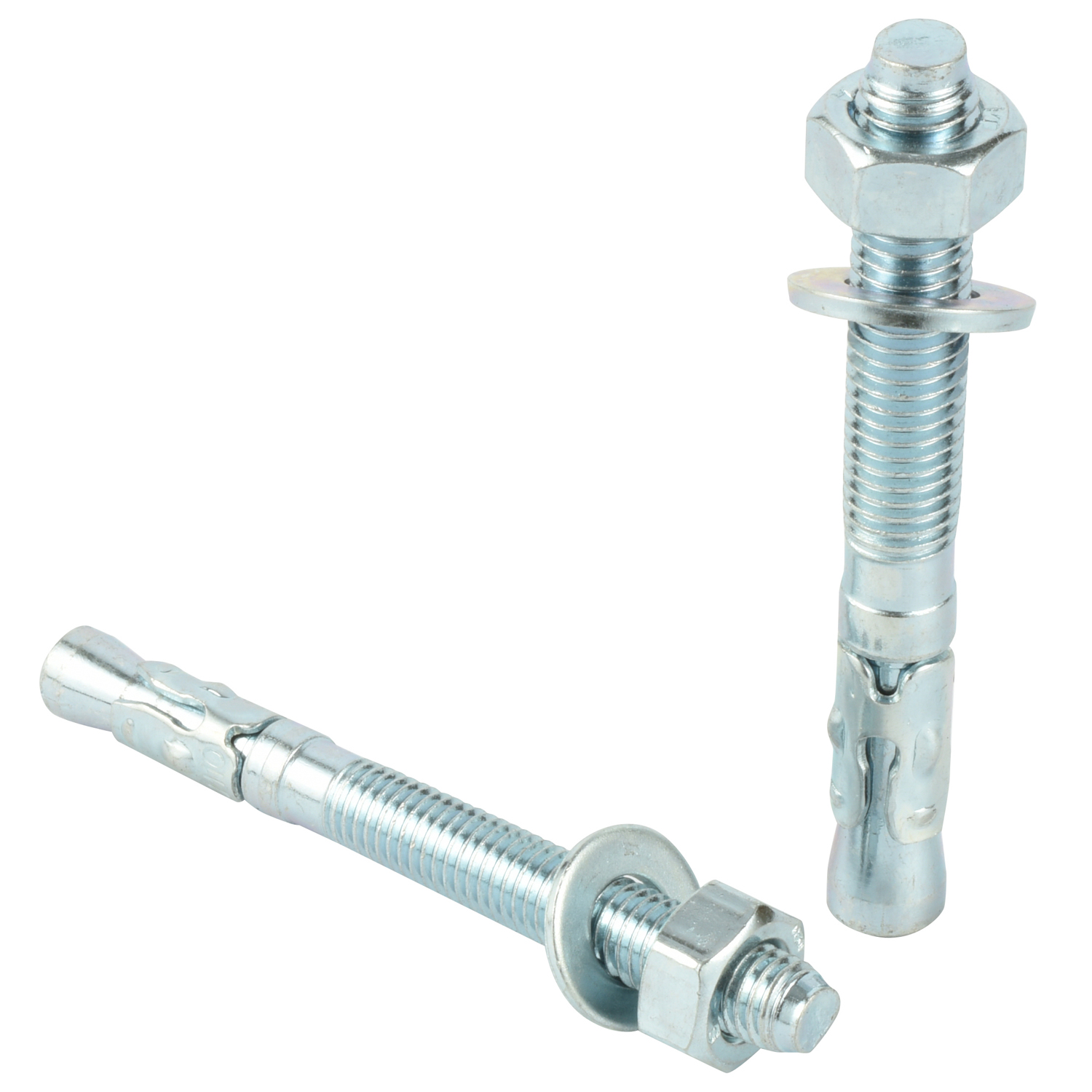
Heavy-duty construction requires permanent, uncompromising connections. The exceptional pull-out resistance of these fasteners makes them indispensable across multiple commercial sectors.
Commercial and residential framing relies heavily on these robust fasteners. Builders use them daily to secure treated wood sill plates directly to poured concrete foundations. This creates a rigid, unmoving base for all subsequent structural framing. High-wind zones especially depend on this secure foundation link.
You will also see them fastening heavy structural steel columns. Massive vertical steel supports require immense pull-out and shear resistance. Ledger boards attached to solid concrete walls also depend on this friction-based grip. The permanent holding power ensures structural integrity under massive static and dynamic loads.
Industrial facilities face unique operational fastening challenges. Manufacturing equipment generates intense, continuous physical vibrations. Over time, these sustained vibrations cause unsecured machinery to "walk" or drift across the factory floor.
You must anchor industrial equipment securely to prevent misalignment and accidents. A heavy-duty wedge anchor effectively stops this dangerous movement. Facilities managers use them to mount rooftop HVAC units safely against high winds. Heavy diesel generators and industrial air compressors also require permanent mounting to dedicated concrete pads. This secure hold protects expensive equipment and ensures factory worker safety.
Modern logistics warehouses demand extreme structural stability. Installing towering pallet racking systems requires precise, high-capacity floor fastening. Forklifts occasionally impact these storage racks during daily operations. The sheer load resistance of a solid fastener prevents total rack collapse during an accidental strike.
Logistics centers also secure extensive conveyor belt supports using these reliable methods. Safety bollards protecting pedestrian walkways rely on the exact same underground grip. You protect vital infrastructure and inventory by specifying the correct anchor for these high-impact commercial zones.
Mechanical strength becomes completely irrelevant if the metal itself corrodes. Rust destroys the internal expansion clip long before the steel body fails. Eventually, the fastener loses friction and fails entirely. You must perfectly match the alloy coating to your specific environmental exposure. This decision prevents dangerous structural degradation over time.
These represent the most common and cost-effective option on the market. Manufacturers coat the underlying carbon steel with a very thin zinc layer. You should use these exclusively in dry, strictly indoor environments.
Think of climate-controlled warehouses, interior residential basements, or enclosed commercial spaces. They carry clear limitations. Standard zinc plating offers only minimal corrosion resistance. The metal will rust quickly if exposed to ongoing moisture or high humidity. Never specify standard zinc-plated options for outdoor projects or wet interior spaces.
This distinct coating process provides a much thicker layer of protective zinc. You can confidently use hot-dipped galvanized anchors in humid indoor environments. They also perform exceptionally well in standard exterior applications exposed to rain.
Contractors frequently use them to fasten pressure-treated lumber. This specific lumber contains corrosive chemical preservatives like copper azole. These chemicals quickly eat through standard zinc plating. The thick galvanized coating resists these harsh chemicals effectively. However, they remain unsuitable for coastal areas. Submerged underwater applications will also eventually degrade the galvanized layer.
Harsh environments demand superior metallurgical properties. Solid stainless steel offers ultimate protection against rapid oxidation and chemical attack. You should select 304 stainless steel for persistently wet, exterior environments. It handles rain, snow, and standard weather exposure brilliantly.
Highly corrosive environments require the upgraded 316 stainless steel alloy. We see 316 exclusively used in coastal areas and saltwater applications. Chemical manufacturing plants and strict food processing facilities also mandate 316 stainless alloys for sanitation and safety. They carry a notably higher initial cost. Regardless, you need them for long-term safety and strict code compliance in brutal conditions.
Knowing exactly when to avoid a specific fastener prevents costly field rework. We must establish a clear decision matrix for alternative products. Sometimes, the base material simply does not support extreme expansion pressure. Other times, you may need a fully removable solution. Here is how they compare against common concrete alternatives.
Sleeve anchors function differently. They distribute their expansion force over a much larger surface area. The metal sleeve runs nearly the entire length of the anchor body. This broad force distribution makes them highly versatile.
You can safely use sleeve anchors in softer or hollow materials. They perform reliably in brick, cinder block, and standard mortar joints. The expansion force will not blow out the softer masonry.
Decision rule: Specify a wedge anchor for maximum load capacity in solid poured concrete. Specify sleeve anchors for masonry, brick, or entirely unknown base materials where concrete density is questionable.
Concrete screws utilize an entirely different mechanical principle. They physically cut precise threads directly into the concrete wall. They do not rely on outward expansion pressure to hold tension.
Because they lack expansion pressure, they are fully removable. They also allow for much closer edge distances without fracturing the concrete slab. You can install them closer together than expansion-style fasteners.
Decision rule: Specify wedge-style fasteners for permanent, extreme heavy-duty loads. Specify screw anchors for temporary installations. They also excel for lighter loads or when you must work dangerously close to the edge of a concrete slab.
Fastener Type | Optimal Base Material | Primary Load Application | Removability | Edge Distance Flexibility |
|---|---|---|---|---|
Wedge Anchor | Solid concrete only | Permanent, extreme heavy-duty | No (permanent installation) | Low (requires large edge distance) |
Sleeve Anchor | Brick, block, masonry, concrete | Medium to heavy-duty | No (usually permanent) | Moderate (broader force distribution) |
Concrete Screw | Concrete, brick, block | Light to medium-duty, temporary | Yes (fully removable) | High (can install near edges) |
Product defects rarely cause catastrophic structural blowouts. Industry data shows an overwhelming majority of failures stem directly from human error. Upwards of 90% of anchor failures occur due to improper installation techniques. You must follow strict operational procedures to guarantee maximum safety.
Precision drilling dictates your ultimate holding power. You must use an ANSI-standard carbide drill bit. The hole diameter must match the anchor diameter exactly. For example, a 1/2-inch fastener strictly requires a 1/2-inch drill bit.
Using a worn or incorrectly sized bit is a common mistake. A slightly oversized hole prevents the expansion clip from gripping the concrete walls effectively. The fastener will simply pull out under load.
Cleaning the hole remains equally critical. Trapped concrete dust acts like a harmful microscopic lubricant. It physically prevents the wedge clip from biting into the solid concrete.
Drill the hole at least 1/2 inch deeper than the required embedment depth. This gives residual dust somewhere to settle.
Use a stiff wire brush to vigorously loosen trapped debris from the walls.
Blow out all concrete dust using compressed air or an industrial vacuum.
Every reputable manufacturer publishes specific technical data. You must define and respect the Minimum Embedment Depth (MED). This is the exact depth required to achieve published load values. Installing the fastener too shallow severely compromises both shear and tension resistance.
Torque application requires precision tools. You must use a calibrated torque wrench for final setting. Relying on "feel" causes dangerous inconsistencies.
Over-torquing represents a severe structural risk. It can physically spin the anchor inside the hole, completely destroying the friction grip. Under-torquing is equally dangerous. Failing to tighten the nut adequately means you never fully set the expansion clip against the concrete walls.
Structural engineers meticulously calculate the "cone of failure." When a fastener experiences extreme tension, it pulls against a cone-shaped section of surrounding concrete. If you place anchors too close together, these failure cones overlap.
Overlapping failure cones drastically weaken the surrounding concrete base. The material can no longer support the combined load. Similarly, avoid placing them too close to an unsupported edge. The massive outward expansion force needs surrounding concrete mass to absorb the pressure.
If you place it near a slab edge, the concrete will spall. The edge will literally blow out and crumble under applied load. Always consult the manufacturer spacing charts to maintain structural integrity.
Let us review the fundamental realities of concrete fastening. These specialized expansion fasteners represent the absolute gold standard for heavy, permanent installation. They deliver unmatched performance and safety in solid concrete. However, you must strictly respect their environmental limits, base material rules, and load parameters.
A successful installation requires strict precision from start to finish. You cannot cut corners on hole cleaning, torque settings, or embedment depth. Take immediate action on your next project by evaluating your base material rigorously. Ensure it is definitively solid concrete, not hollow block.
Assess your environmental risks regarding moisture, salt, and chemicals. Always match the metallic alloy to the local exposure level. Finally, consult official load charts or speak with structural engineers before finalizing your spec sheet. Precision planning ensures permanent safety and total code compliance.
A: No, they are designed as permanent structural fasteners. The mechanical expansion clip locks irreversibly into the surrounding concrete. To "remove" one, you must take the top nut off. Then, you either pound the exposed threaded stud completely flush into the concrete or cut it off smoothly using an angle grinder.
A: No. The intense outward expansion force will crack and shatter softer masonry. This catastrophic failure compromises the entire structural hold. For hollow block, brick, or mortar joints, you must specify a sleeve anchor or an epoxy adhesive system instead.
A: The exact depth depends entirely on the diameter of the specific anchor. However, you must strictly adhere to the manufacturer's Minimum Embedment Depth requirements. Achieving this specific depth is legally mandatory to reach the official rated holding values published in their engineering charts.
A: The drill bit size is always exactly equal to the anchor diameter. For example, a 1/2-inch fastener strictly requires a 1/2-inch ANSI-standard carbide drill bit. Never use an oversized bit. A hole that is too large prevents the expansion clip from gripping the concrete.
