 English


Securing heavy loads to concrete is never just a simple hardware purchase. It is a safety-critical engineering decision requiring immense precision. A single failure can trigger catastrophic structural collapse, jeopardizing entire projects. Failing to understand the mechanical physics of expansion anchors often leads to severe consequences. You risk catastrophic load failures, base material blowouts, and severe compliance violations. True structural integrity demands complete awareness of how these fasteners function under pressure.
We will explore the precise friction-based mechanics governing these heavy-duty fasteners. We will define their strict base material requirements. You will learn the exact evaluation criteria for specifying safe load capacities. Furthermore, we will guide you in choosing the correct material for demanding commercial and heavy industrial applications.
Mechanism: Wedge anchors rely on torque-controlled friction; tightening the nut pulls a cone-shaped base into an expansion clip, wedging it permanently into solid concrete.
Strict Base Limitations: They are engineered exclusively for fully cured (28-day) solid concrete, not for hollow block, brick, or "green" concrete.
Torque is Mandatory: Improper torqueing can result in up to a 50% loss in clamping force due to load relaxation. Calibrated torque wrenches are non-negotiable for compliance.
Permanence: Installation is one-way. They cannot be extracted without damaging the base material or shearing the stud.
To specify fasteners correctly, engineers must understand their internal physics. A Wedge anchor is not a static peg. It acts as a dynamic tension device. It generates immense holding power through specialized geometry. You must recognize how each physical component contributes to overall structural safety.
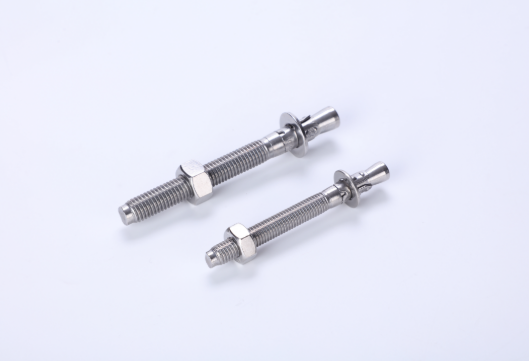
These fasteners utilize a simple yet highly effective four-part assembly. Each part plays a non-negotiable role in creating friction.
The Threaded Anchor Body (Stud): The main shaft features standard threading at the top. The bottom section flares out into a tapered, cone-shaped base.
The Expansion Clip (Collar): A segmented metal sleeve wraps around the lower portion of the stud. It features small teeth or ridges to grip concrete.
The Hex Nut: This standard nut provides the mechanical interface. Turning it generates the upward axial pull required for activation.
The SAE Washer: A specialized flat washer sits below the nut. It distributes the clamping load evenly across the fixture surface.
Holding power relies entirely on "torque-controlled friction." You insert the fastener into a pre-drilled hole. Next, you apply torque to the hex nut. This rotational force pulls the threaded rod upward. As the stud rises, the tapered bottom forces itself into the stationary expansion clip. The expanding clip pushes outward aggressively. It bites deep into the rigid concrete walls. This creates a permanent mechanical lock.
Technical vocabulary changes depending on your geographic region. In the US market, professionals universally call them wedge anchors. However, UK and European engineers often refer to them as "throughbolts." In those overseas markets, the term "wedge anchor" frequently denotes a drop-in deformation anchor instead. Understanding this terminology ensures you order the correct parts for international projects. It also prevents dangerous compliance mix-ups.
Not every project requires extreme holding power. Specifying the wrong anchor wastes money and compromises safety. You must evaluate your load profiles carefully. You must also verify your base material characteristics before proceeding.
These specialized fasteners excel under severe conditions. They support heavy static loads. They also handle dynamic vibratory loads beautifully. Typical applications include steel columns, elevator guide rails, and heavy industrial machinery. Proper installation guarantees ICC-compliant holding power. High-end specifications can easily support loads exceeding 6,000 lbs. They are the ultimate choice for critical structural engineering.
Because they rely on torque-controlled friction, they exert massive outward stress. This concentrated stress demands a solid, unyielding surrounding material. They must never secure items to masonry. Hollow block and brick will simply shatter. Furthermore, you cannot use them in uncured concrete. "Green" concrete lacks the necessary compressive strength. You must observe a minimum 28-day cure time before drilling.
Engineers often debate between wedge and sleeve fasteners. Sleeve anchors serve a very different purpose. They handle much lighter loads. Their design disperses expansion pressure across a much larger surface area. This wider displacement makes sleeve anchors perfectly acceptable for fragile materials. You can use them safely in brick, block, and mortar.
Performance Comparison Chart
Feature | Wedge Fasteners | Sleeve Fasteners |
|---|---|---|
Load Capacity | Heavy-duty (Up to 6,000+ lbs) | Light to medium-duty (200-1,000 lbs) |
Approved Base Material | Solid concrete only | Concrete, brick, hollow block |
Expansion Mechanism | Concentrated point expansion | Full-length sleeve expansion |
Installation Speed | Slower, precise drilling required | Faster, wider hole tolerance |
Specifying load capacity is only half the battle. You must also evaluate the surrounding environment. Moisture, chemicals, and saltwater attack steel aggressively. Selecting the wrong metal guarantees eventual structural failure.
A high-strength fastener means nothing if it rusts through. You must match the material precisely to the exposure risk. Doing so prevents galvanic corrosion. Galvanic corrosion occurs when dissimilar metals interact. It rapidly destroys the fastener body. You must assess humidity, outdoor exposure, and chemical proximity.
Carbon steel provides excellent sheer strength. Manufacturers coat these parts in a thin layer of zinc. This electroplating process offers minimal rust protection. They are highly cost-effective. However, they remain suitable only for dry, indoor environments. You should strictly limit their use to spaces featuring controlled, low humidity.
Hot-dipped galvanized options provide a much thicker zinc barrier. This rugged coating offers moderate corrosion resistance. It effectively stops moisture penetration under normal conditions. You will typically specify these for standard outdoor applications. They perform well securing exterior lighting poles or outdoor fencing.
Extreme environments demand extreme metallurgy. A steel wedge anchor manufactured from 304 or 316 stainless steel delivers superior longevity. Type 316 includes added molybdenum. This chemical addition prevents pitting from chlorides. Stainless steel remains the required specification for marine environments. You must also mandate it for chemical plants or areas facing continuous moisture.
Even the strongest materials fail if installed incorrectly. Installation requires exact precision. Careless drilling compromises holding power immediately. You must train contractors on strict geometric tolerances.
The hole dictates the holding power. The drill bit diameter must identically match the fastener diameter. If you use a 3/4-inch anchor, you must use a 3/4-inch bit. We strongly specify the use of PGM-certified carbide bits. PGM certification ensures exact cutting geometry. It prevents dangerous micro-deviations in the hole diameter.
Concrete dust creates a massive hazard during installation. You must drill the hole at least 1/2 inch deeper than your intended embedment. This extra depth accommodates displaced dust. After drilling, you must evacuate the hole entirely. Emphasize clearing the hole using compressed air. Follow up using a stiff wire brush to remove stuck particles.
Driving the fastener requires care. Never strike bare threads. Thread the nut onto the top of the stud first. Make sure it sits flush against the top edge. Strike the nut firmly using a proper hammer. This protects the delicate threads from deformation. Drive the assembly downward carefully. Continue driving until exactly 5 to 6 threads rest below the fixture surface.
Concrete operates under massive internal stress. When an expansion clip activates, it creates a "stress cone" inside the concrete base. Installing anchors too close to the concrete edge invites disaster. The lateral force will blow the concrete chunk outward. Furthermore, installing them too close to each other causes intersecting stress cones. This overlap multiplies internal pressure, risking catastrophic blowout. Always follow manufacturer guidelines for minimum spacing.
Installation Checklist
Verify 28-day concrete curing time.
Select a PGM-certified bit matching the anchor diameter.
Drill 1/2 inch deeper than the required embedment depth.
Evacuate dust using compressed air and a wire brush.
Thread the nut onto the stud to protect threads.
Hammer the assembly until 5-6 threads sit below the surface.
Apply specified torque using a calibrated tool.
A tightened nut does not stay tight automatically. Field failures often occur weeks after a successful installation. You must understand how concrete behaves under sustained pressure. Ignoring this behavior causes dangerous liability issues.
We must address a very common field failure known as load relaxation. Concrete is not completely solid on a microscopic level. It contains tiny voids and pores. Shortly after installation, the initial clamping force crushes these micro-structures. The concrete locally compresses and sets around the expansion clip. As the material yields, the clamping force drops significantly. Sometimes, you lose up to 50% of your initial holding power.
Contractors often rely on "feel" to tighten nuts. They might just turn the wrench 3-4 times. This guesswork is incredibly risky for load-bearing structures. Load relaxation will weaken this loose connection further. You must mandate the use of a calibrated torque wrench. Set the tool to the exact manufacturer specifications. Re-torque if necessary after a specified settling period. Strict torque control maintains code compliance. It meets stringent ICC-ES and BS8539 requirements.
Engineering success relies on precise physical execution. Expanding fasteners provide highly reliable, permanent fastening solutions. However, they only succeed when you respect the physics of torque-controlled expansion. You cannot bypass structural rules without risking failure.
Always evaluate your specific load requirements before purchasing materials.
Confirm your concrete base possesses a full 28-day cure.
Select the appropriate steel grade based on moisture and chemical exposure.
Use precision tools to manage dust, depth, and torque tolerances.
Advise engineers and contractors to verify all compliance codes before beginning procurement. Never leave tightening to guesswork. To ensure compliance, we suggest embedding a 2-5 minute installation demonstration video for all field crews prior to deployment.
A: No. The expansion clip permanently lodges into the concrete. The internal teeth bite deep into the walls, making extraction impossible. The only removal methods involve cutting the exposed stud flush with an angle grinder or attempting to core drill it out.
A: No. Installing in "green" concrete compromises the holding capacity entirely. Fresh concrete yields under expansion pressure. The concrete must cure for a standard 28 days to reach its design compressive strength before drilling.
A: Stop immediately. Do not attempt to force the anchor into a shallow hole. You must consult the site structural engineer. Usually, the hole must be completely abandoned, filled with epoxy, and relocated to a safe distance.
